
Master the Blade: Essential Knife Skills for Every Home Cook
Improve your speed, safety, and cooking results by mastering fundamental knife skills. Learn professional grips, essential cuts, and maintenance tips.
Emma Chen
Recipe Developer
May 16, 2026
5 min read
3 views
A sharp knife and the skill to use it are the most valuable assets in any kitchen. Many home cooks approach prep work as a tedious chore, struggling with uneven vegetable chunks or, worse, risking injury with improper technique. When your ingredients are cut into uniform sizes, they cook at the same rate, preventing the frustration of finding a crunchy potato next to a mushy one. Mastering a few fundamental techniques will not only speed up your meal preparation but also give you the confidence to tackle more complex dishes with ease.
Everything begins with how you hold the tool. Many beginners instinctively wrap all four fingers around the handle, leaving the index finger extended along the spine. This 'hammer grip' lacks stability and precision. Professional chefs use the 'Pinch Grip.' By choking up on the knife and pinching the bolster—the thick part where the blade meets the handle—between your thumb and the side of your index finger, the knife becomes an extension of your arm. This gives you maximum control and reduces wrist fatigue during long prep sessions.
The Damp Towel Trick
To prevent your cutting board from sliding around while you work, place a damp paper towel or a thin kitchen cloth underneath it. A stable surface is the first step toward safety and precision.
While your dominant hand controls the knife, your non-cutting hand is equally important. This hand should adopt the 'Claw Grip.' Curl your fingertips inward toward your palm, using your knuckles as a guide for the blade. This keeps your fingertips far away from the sharp edge. As you cut, slide your hand back gradually, maintaining that knuckle contact to ensure consistent thickness for every slice.
The Danger of Dull Blades
It may seem counterintuitive, but a dull knife is far more dangerous than a sharp one. A dull blade requires more force to cut through food, making it more likely to slip and cause a deep injury. Keep your knives sharp to ensure they bite into the food rather than sliding off it.
Once you have mastered the grip and safety, you can focus on the mechanics of the cut. For most tasks, a 'rocking motion' is most efficient. Keep the tip of the knife in contact with the board and use the curved belly of the blade to slice through the ingredient in a circular, downward-and-forward motion.
The Batonnet
Start by squaring off your vegetable (like a potato or carrot) into a rectangular block. Slice this block into planks 1/4 inch thick. Stack the planks and slice them again into 1/4 inch wide sticks. You now have the 'batonnet' cut, which is the foundation for a perfect dice.
The Small Dice
Take your batonnet sticks and gather them together. Cut across the sticks at 1/4 inch intervals. This creates uniform cubes, ensuring that every piece of vegetable in your pan will soften at exactly the same time.
The Chiffonade
For leafy greens or herbs like basil, stack the leaves and roll them tightly like a cigar. Slice across the roll into thin ribbons. This technique prevents bruising the delicate leaves and creates a beautiful garnish.
"A knife is not just a tool; it is the bridge between raw ingredients and a finished dish. Precision in the prep phase is what separates a good cook from a great one."
OttoChef Culinary TeamBeyond the cuts themselves, understanding the anatomy of your equipment helps you choose the right tool for the job. While a 8-inch chef's knife is the workhorse for 90% of kitchen tasks, a smaller paring knife is essential for delicate work like peeling or removing seeds. A serrated bread knife is necessary for items with a hard crust or soft, waxy skin, like tomatoes.
Forged vs. Stamped
Forged knives are made from a single piece of heated steel that is hammered into shape, resulting in a heavier, more durable blade with a bolster. Stamped knives are cut out of a sheet of steel; they are lighter and often more affordable, though they may lack the balance of a forged blade.
Maintenance is the final pillar of knife skills. Many people confuse 'honing' with 'sharpening.' Honing involves using a ceramic or steel rod to realign the microscopic teeth of the blade that get bent out of shape during use. You should hone your knife almost every time you use it. Sharpening, however, actually removes metal to create a new edge and only needs to be done once or twice a year depending on usage.
Choose the Right Board
Avoid cutting on glass, marble, or granite surfaces. These materials are harder than the steel in your knife and will dull your edge almost instantly. Stick to wood or high-quality plastic boards to preserve your blades.
To improve your skills, practice deliberately. Don't rush through the onions for tonight's dinner; instead, focus on your finger placement and the uniformity of the pieces. Within a few weeks of mindful practice, the 'claw' and 'pinch' will become second nature. You will find yourself moving faster, cooking more evenly, and enjoying the process of preparation just as much as the meal itself.
Try This Recipe
Now that you've learned about essential knife skills every home cook should master, put your knowledge into practice with this recipe:
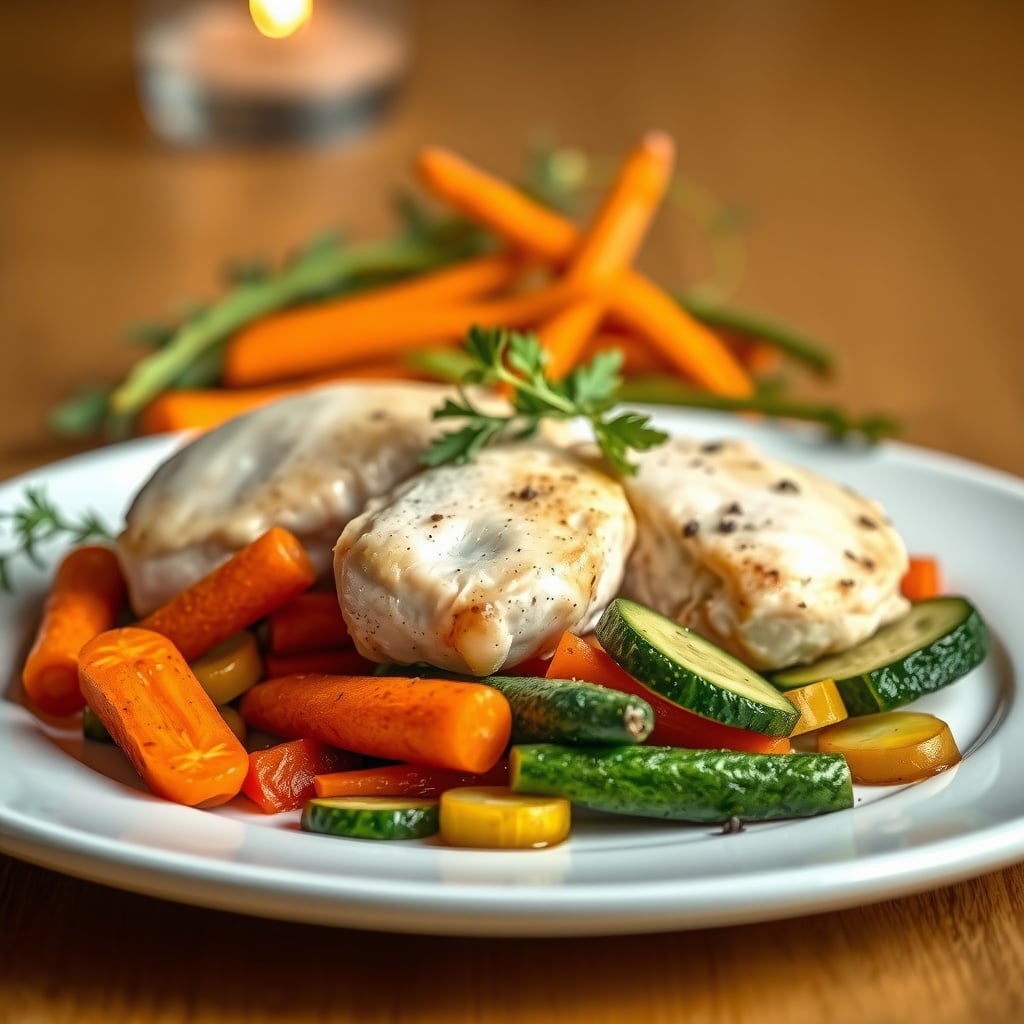
Knife-Skills Garden Chicken with Batonnet Vegetables
55min
4
View Full Recipe →
Ready to simplify your meal planning?
Let OttoChef AI create personalized meal plans for your family in seconds.