
How to Double and Halve Recipes Without Ruining Dinner
Master the art of scaling recipes up or down for any family size. Learn which ingredients scale perfectly and which need adjustment for cooking success.
Sarah Mitchell
Test Kitchen Director
March 21, 2026
7 min read
8 views
You've found the perfect recipe, but it serves four and you're cooking for eight. Or maybe you're alone tonight and that casserole serves six. The math seems simple—just multiply or divide everything by two, right? Not quite. Recipe scaling is more nuanced than basic arithmetic, and understanding these principles will save you from bland soups, rubbery baked goods, and overcooked proteins.
The Golden Rule: Not Everything Scales Linearly
The fundamental truth about recipe scaling is that ingredients behave differently when quantities change. A doubled recipe isn't just twice the ingredients in a bigger pot—it affects cooking time, heat distribution, and chemical reactions. Understanding which elements scale directly and which require adjustment is the foundation of successful recipe modification.
The 1.5x Sweet Spot
When cooking for slightly larger groups, multiply by 1.5 instead of doubling. It's easier to manage, fits standard cookware better, and reduces the risk of overcooking or uneven results.
Ingredients That Scale Perfectly
Some ingredients are straightforward—they scale up or down without fuss. Proteins, vegetables, pasta, rice, and grains can be multiplied or divided directly. If a recipe calls for 2 pounds of chicken thighs for four people, 4 pounds will serve eight. These structural ingredients maintain their properties regardless of quantity.
Liquids like broth, water, and milk also scale directly in most cases. The exception comes when you're dealing with evaporation—more on that shortly. Oils and fats for sautéing generally scale well, though you might not need to double them completely since larger quantities often release more natural fats during cooking.
The Baker's Percentage
Professional bakers use a percentage-based system where flour is always 100% and other ingredients are expressed as percentages of the flour weight. This makes scaling foolproof. A 70% hydration dough uses 70g water per 100g flour, whether you're making one loaf or twenty.
The Tricky Territory: Seasonings and Spices
Here's where intuition fails most home cooks. Seasonings don't scale linearly because taste perception doesn't work that way. When you double a soup recipe, you don't need double the salt—usually 1.5 times is sufficient. This applies to most bold seasonings: garlic, ginger, hot peppers, dried herbs, and especially salt.
"Start with 60-75% of the scaled seasoning amount, then taste and adjust. It's easier to add than subtract."
Traditional culinary wisdomFresh herbs are more forgiving and can scale closer to directly, but dried herbs and ground spices become overwhelming when doubled exactly. The concentration of flavor compounds increases disproportionately in larger volumes. For a doubled recipe, start with 1.5 times the spices, cook partially, taste, and adjust.
Vanilla extract, citrus zest, and other aromatic extracts follow similar rules. Their volatile compounds become more pronounced in larger batches, so scale conservatively.
Cooking Time: The Non-Linear Variable
This surprises many cooks: doubling a recipe doesn't mean doubling the cooking time. A doubled batch of cookies still bakes at the same temperature for roughly the same time because each individual cookie is the same size. The same applies to individual portions like chicken breasts or fish fillets.
However, large-format dishes behave differently. A doubled casserole in a larger dish needs more time because heat must penetrate to the center. A halved stew might finish 20-30% faster, not 50% faster, because the liquid-to-surface-area ratio changes.
The Overcrowding Problem
When doubling recipes, resist the urge to cram everything into the same pot. Overcrowding drops temperature, creates steam instead of browning, and leads to uneven cooking. Use a larger vessel or cook in batches.
Leavening Agents: The Chemistry Challenge
Baking powder, baking soda, and yeast require careful attention when scaling. These ingredients create chemical reactions that depend on ratios, time, and environment—not just quantity. When halving a baking recipe, round leavening measurements up slightly rather than down. A recipe calling for 1.5 teaspoons of baking powder should use 1 teaspoon when halved, not 0.75 teaspoons.
For yeast breads, the relationship is even more complex. Yeast multiplies regardless of the dough size, so timing matters more than quantity. A halved bread recipe might use slightly less than half the yeast and still rise perfectly, while a doubled recipe doesn't necessarily need double the yeast—1.5 times often suffices because the larger mass retains heat better, promoting fermentation.
Practical Scaling Strategies
Calculate Core Ingredients
Start by scaling proteins, vegetables, and main liquids directly. These form the foundation and are the most forgiving.
Adjust Seasonings Conservatively
Use 60-75% of the mathematically scaled amount for salt, spices, and strong aromatics. You'll adjust later.
Consider Your Cookware
Ensure your pot or pan can accommodate the new volume with proper heat distribution. The liquid should be no more than two-thirds full for stews and braises.
Monitor and Taste
Start checking for doneness at 75% of the original time for doubled recipes, 60% for halved recipes. Taste and adjust seasonings when the dish is nearly complete.
Special Considerations for Common Dishes
Soups and stews handle scaling well, but remember that evaporation rates don't scale linearly. A doubled pot of soup loses proportionally less liquid to evaporation because the surface area increases less than the volume. You might need slightly less liquid than a pure doubling would suggest.
Sauces present their own challenge. Reduction sauces concentrate flavors as liquid evaporates, so a doubled sauce reduces faster than you'd expect due to increased surface area. Start with 1.75 times the liquid rather than double, and reduce carefully.
Casseroles and baked dishes need attention to depth. A doubled casserole spread across a larger pan (maintaining similar depth) cooks at nearly the same rate as the original. But if you use a deeper dish, increase time by 25-40% and check internal temperature.
The Weight Advantage
Kitchen scales eliminate scaling confusion. Measure ingredients by weight rather than volume, then multiply or divide precisely. 250g flour doubled is exactly 500g—no wondering if you packed the measuring cup correctly.
The Halving Advantage for Skill Building
When trying a new recipe or unfamiliar technique, halving offers a safety net. Smaller quantities are more forgiving, cook faster, and waste less if something goes wrong. You'll learn the technique with less pressure and can scale up once you've mastered the fundamentals.
This approach works brilliantly for expensive ingredients or time-intensive dishes. Make half a batch of handmade pasta, half a recipe of complex curry, or half a fancy dessert. Once you've nailed the technique, scale up with confidence.
Beyond Simple Math
The most important skill in recipe scaling isn't calculation—it's understanding how ingredients interact. A recipe is a living system where components affect each other. Heat, time, and chemistry create the final dish, not just ingredient ratios.
Trust your senses as much as your measurements. Does the sauce look too thin? The stew smell under-seasoned? These observations matter more than rigid adherence to scaled numbers. Professional cooks scale recipes constantly, adjusting by sight, smell, and taste rather than formula alone.
Start practicing with forgiving recipes: soups, stews, grain dishes, and simple roasts. Build confidence with these before tackling finicky baked goods or delicate sauces. Each successful scaling teaches you more about ingredient behavior and cooking dynamics.
The ability to adapt recipes to your household size transforms cooking from following instructions to genuine culinary skill. You'll waste less food, cook more efficiently, and gain the flexibility to handle any dinner scenario—from cooking for one to feeding a crowd. That's not magic; it's practical knowledge applied with attention and care.
Try This Recipe
Now that you've learned about doubling and halving recipes for different family sizes, put your knowledge into practice with this recipe:
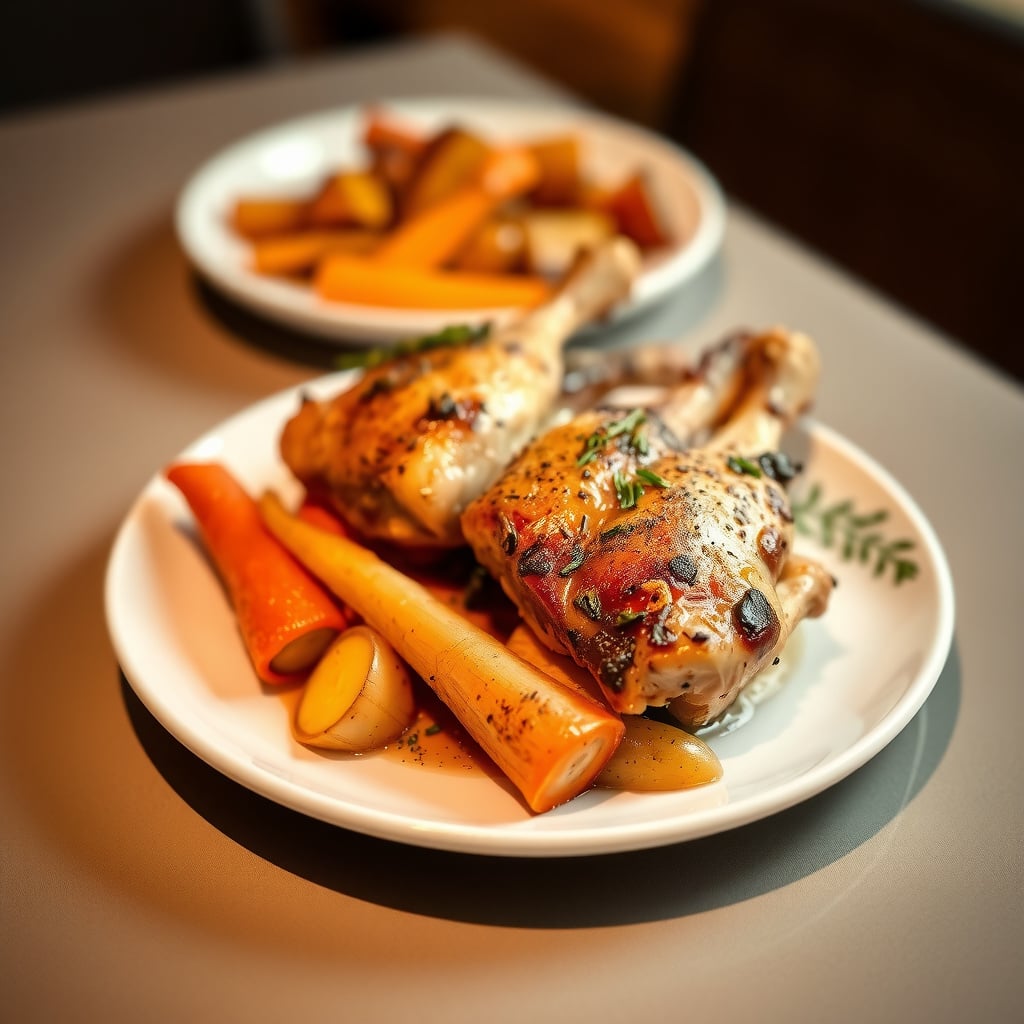
Scalable Herb-Roasted Chicken Thighs with Root Vegetables
60min
4
View Full Recipe →
Ready to simplify your meal planning?
Let OttoChef AI create personalized meal plans for your family in seconds.